DANIEL
(*****L): French
Chef Daniel Boulud received his 3rd Michelin
Star in 2010; he lost one star in 2015. It took the Red Guide decades
to give the
supreme consecration to Boulud; it took only five years to punish this
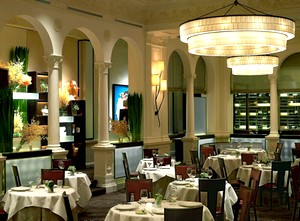
generous, epicurean chef who achieved his With or without Michelin, what changed until now, in 2021? Nothing? Visiting this cathedral of fine dining is somehow like attending a Sunday Mass. Dressed to kill clients respectfully visit the softly lighted, temple-shaped main dinning room, to solemnly receive the benediction from Saint Fortuna and Bacchus (who else could have inspired Boulud such a divine cuisine?). Finally comes the moment when one's take the collection... For a majority of patrons, the bill doesn't matter. And those who pay with each dollar they saved for a visit never claim: this restaurant is worth the trip. Boulud has spent millions of dollars to make his flagship restaurants as elegant, splendiferous and comfortable as possible. Daniel is everything but trendy. We fell and even smell the essence of luxury right on the doorstep. But the strength of the cuisine, the quality of the wine, and the anticipating attitude of the perfectly trained staff are the elements which made our visit unforgettable. Paul Bocuse, La Mère Blanc, Le Moulin de Mougins, Les Prés d'Eugénie: those mouth watering, prestigious 3 Michelin Star restaurants are places where Daniel Boulud learned how to prepare a hearty, proficiently inventive French cuisine. Now a restaurateur, he has two gifted disciples in the cyclopean two-storey kitchen with its own backery: Jean-François Bruel is the Executive Chef, and Eddy Leroux the Chef de Cuisine. The young Bruel worked for Georges Blanc, Paul Haeberlin and Michel Guérard, showing many coincidences with his mentor career. Including the talent... Most of the dishes that we have enjoyed came from the “Six Course Tasting” menu. At USD 175, we found it an almost incredible value for money. The wine pairing was USD 95, for a clever, ideal selection of the finest vintage brands. For those still hesitant, our description will just feature the price for wine by the glass. We had a couple of appetizers. “Foie Gras Terrine, With Yellow Peaches”, Marcona Almond Panna Cotta and Purslane Salad. Classic and refined. Our Mosel wine, “R. Haart Riesling, Piesport Kabinett, 1999” (USD 16) was still so young, mineral, with -and this is why it paired our dish so well!- white peach flavours. Boulud's cuisine is called “French-American”: which we could see with the “Marinated Fluke, with Seaweed”, Pine Nuts, Radishes, Matsutake Mushrooms, and Bonito Gelée. The Fluke is one of New Jersey's most common flatfishes, with a fine, tender and firm texture, and a sweet, delicate flavor. In Daniel quite Asiatic preparation, it tasted something like jelly fish. We were logically expecting an American wine; but got an Austrian “Grüner Veltliner “Freiheit”, Nigl, Kremstal 2008” (USD 16), loaded with minerals and balanced by just the right amount of offsetting fruit. The “Butter Poached Abalone”, Yellow Curry Braised Greens, Crispy Rice, Chayote, was also reminiscent of Asia. This aristocratic delicacy -one of the most expensive seafood in the world- was not imported from South East Asia... but from Monterrey, California. Maybe was it slightly harder than the abalones we enjoyed in Thailand and Singapore, where they got boiled and long time processed before being mixed up with rice; here, it was served braised in its shell, with its original flavour almost untouched. Unique! Excellent pairing: a French “Domaine de Terrebrune, Bandol, Provence 2006” (USD 23). Terrebrune is an estate which uses only organic farming, and produces a remarkable regional wine. The “Elysian Fields Farm Lamb Chop”, with Garbanzo Bean Fricassée, Chorizo, Rutabaga, and Chickpea Tendrils was terrific: with the Chorizo oil bringing a peasant energy to the mild, delicate taste of the lamb. Warmly recommended. Lovely with a glass of Californian “Ridge, “Santa Cruz Mountains Estate”, Santa Cruz 2006” (USD 25). Another main course made us great impression: the “Turbot Baked on Himalayan Salt”, Root Vegetables, Ommegang Abbey Ale and Gingerbread Sauce. We don't like that much having red white with fish, moreover when the turbot is so nicely textured and flavoured; but we must confess that our glass of “Chehalem, Pinot Noir, “3 vineyards” 2007” (USD 25) was an expert pairing. 2007 was a great vintage in Oregon, for a complex, remarkable wine. Note that the Turbot was not on the six courses menu, but on the “Three Course Prix Fixe” (USD 105). Everybody is a VIP at Daniel... but let's be little bit more than the others and, like P Diddy and Jay-Z, let's try the “Bling” and amazingly delicious season's first white truffle from Alba, ceremoniously shaved by the white-gloved maitre d' over a “Creamy Risotto with Parmesan”, “Spaghetti Alla Chittara” or, and this was like a day dream, “Handmade Taleggio Agnolotti”: a kind of ravioli stuffed with Taleggio cheese, from the area of Bergamo. Its flavour is comparatively mild with an unusual fruity tang. It was a perfect combination with the truffle. Truffle supplement is USD 60 for “Tasting”; USD 110 for “Appetizer”; USD 180 for “Main Course”. Such an incomparable dish came with a generous, charismatic “Meursault, Domaine Drouhin, Burgundy 2006” (USD 28). Voted one of the Top Ten Pastry Chefs in America, Dominique Ansel excels in confectioning chocolate cakes. His “Duo of Fruits and Chocolate Desserts” was a classy delight and a perfect illustration of his maestria. Alternatively, The “Chocolate and Peanut Butter Ganache”, Praliné Feuilleté and Caramel Ice Cream, was ideally textured. Even more inventive in term of flavour, we loved the “Lychee and Cranberry Vacherin”, Candied Rose Petal, crème Chantilly. This was all extremely light, and not over sweet. Dazzling with a glass of honey like “Château Pajzos, Tokaji Aszu, 5 Puttonyos, 2006” (USD 28). This dinner simply took our breath away. The cuisine was more than ever well worth 3 Michelin Stars. It is even four star (the highest rating, from The New York Times). Definitely not two... The staff is so attentive, so kind: it seemed that at least three persons where working just for our table. The French maître d' was a our disposal for describing the dishes, and giving plenty of information about the origin of the ingredients. He is a living gourmet encyclopaedia, and knows everything about cheese from round the world. The sommelier, was so enthusiastic that he made us drink the whole wine cellar just by describing its treasures. Daniel Boulud was in the room, and had kind words to each guest. The guy is so authentic, that he won't make the difference in term of treatment between a farmer from Oregon and a movie star from Hollywood. We include Daniel in our personal classification of the best restaurants in the world. Managed
by Group
Daniel Boulud, this is a Relais
& Chateaux. PHONE +1 212 288 0033 FACSIMILE: + 1 212 396 9014 RESERVATION
LE
BERNARDIN (*****L): With Three Michelin Stars, a four-star
rating
from The New York Times, and a long gastronomic history, this is
Daniel’s
alter ego. The best seafood restaurant in the USA since 1986
appointed
the young, though experienced, Eric Ripert (who worked with From all of the buzz that we heard, the lounge-like, modern teak-toned room of this Midtown-West restaurant was the place for the meal of a lifetime. We were so lucky to get our lunch reservation the last day of our visit in New York that we forgot the stress of flying back to Europe four hours later. We found the concept, described by many as luxurious, on the classy and relaxing side. Almost empty when we arrived at noon, it was full when we had emptied our first glass of Champagne Vranken “Les Demoiselles”. The space between each table assures privacy; it was not easy to catch the accents of the patrons, though it seemed from their proximity with the staff that most of them were regulars, top New York executives and CEOs. The service is impressive, with as many people working the floor as there were dining! Everyone was in constant motion, like a choreographed dance recital. Lunch at Le Bernardin is affordable with options starting from USD 45 for the “City Harvest Menu” (of which USD 5 donated to the food rescue organization). The meal features two courses (“Asian Tuna Tartare”, “Sautéed Codfish”) and a dessert (“Chocolate-Peanut” dark-chocolate tart). The “Three Course Menu” is a gourmet's dream: at USD 68, it features the best available fish on the market (scallop, escolar, black bass, red snapper) and splendid preparations depending on the fish and your own taste (almost raw, barely touched, lightly cooked). Last but not least, the “Chef's Tasting Menu” offers Ripert's specialties: six courses, cheese, and a dessert. At USD 185, those on a short gourmet trip in New York should order it. With the wine pairing, the price is USD 325, but for this price the expert sommelier Aldo Sohm, who has worked at Wallsé, will provide you with delightful wines. We ordered from both menus, and received a parade of delicacies. Our starter was a “Salmon-Caviar” in which the almost raw, thinly Poached Smoked Scottish Salmon came on a thin toasted brioche, with Israeli Caviar Osetra (little, if any difference compared with the Iranian Caviar; perhaps smoother texture). Palatable, with a glass of Krug “Grande Cuvée” which, we agreed with Aldo, beats the Dom Perignon. This was our first step to ecstasy, which was quickly amplified by the “Seared Langoustine”, with Mâche, Wild Mushroom Salad, shaved Foie Gras, and White Balsamic Vinaigrette. This is the kind of dish that earns a chef three stars. It was paired with a Mosel (Germany) “Riesling Estate Feinherb, Karthäuserhof 2008”: very bright, and full-flavored, with notes of complex spices. This was one of our favourite dishes as well as the lightly Cooked “Pan Roasted Monkfish”. We are certainly fond of Monkfish, but its flesh was smooth and enriched by the Sake broth and the Turnip-Ginger Emulsion and the savory flavor of the Hon-Shimej Mushrooms. This pure marvel can be ordered from the “Three Course Menu” which is a gift! Aldo suggested us to have it with a green-yellow, aromatic Austrian “Sauvignon Blanc Klausen, Neumeister, 2007”. We would also warmly recommend the “Surf and Turf”, featuring Escolar and Seared Kobe Beef. That's a masterpiece. The taste and the texture of the Escolar were fantastic, and the Kobe Beef, reputedly the best and the most expensive in the world, was sumptuous, with Sea Bean Salad and Eggplant Fries. Again, the kind of dish that pleases both the Michelin guide and gourmand alike. Paired with a Bordeaux “Château Haut-Bages, Averous, Pauillac”, a second label of a legendary Cinquième Cru, it would please the most spoiled gastronome. Le Bernardin has a modest philosophy: “Fish is the star of the plate, not the Chef.” We pondered this idea while waiting for the dessert, when the gastronomic orchestra came under the direction of Michael Laiskonis, the Executive Pastry Chef. This gentleman is a superb confectioner, and a real artist playing on the same level as Laurent Jeannin or Pierre Hermé. His “Pistachio Mousse” with Caramelized White Chocolate Cream, Lemon and Bing Cherry was charismatic, paired with a glass of honey-like Sauterne, “Château La Rame, Sainte Croix Mont, 1998,” or -believe it or not!- some beer from the Trappist abbey of Westmalle (Belgium). The beer pairing developed the hidden aroma of the mousse. A little bit more classic offering, but so yummy, was the “Chocolate-Chicory” with Dark Chocolate Crèmeux, Cocoa Pain de Gènes, Burnt Orange Meringue and Chicory Ice Cream. It tastes like the Seventh Deadly Sin. One drop of South Eastern Australian “Yalumba NV Museum Reserve Muscat”, and you finally feel like you are in Paradise. While this was a banquet, we left our table still feeling quite light, almost slim. The cuisine at Le Bernardin is miraculous. Voted the 4th favourite NYC restaurant by Trip Advisor, this is indeed one of the most attractive restaurants in the world. A place where the cuisine truly speaks. LE BERNARDIN: The Equitable Building, 155 W. 51st St. (Sixth & Seventh Aves.) New York, NY 10019 PHONE: +1 212 489 1515 E-MAIL: dine@le-bernardin.com CONTOUR
(*****): This classy Bistro
and Bar has been recently created over a beautiful open-floor plan
design, tying together the Lobby Lounge, Bar, and Restaurant into a
stunning space overlooking 6th Avenue and perfectly mirroring the
hotel’s impeccable classic
BOULUD
SUD (****): We
believed that we had inspected all Daniel Boulud's restaurants. Then
what happened?: the most dynamic and best restaurateur in America
opened a new fine table, between Broadway and Central Park West. Boulud
Sud is a bright and cool 120 seats CAFE
BOULUD (****): One Michelin star, this is since 1998 one
of the
most sought after addresses in the heart of the posh Upper East
Side. Located just in front of the Carlyle, one of the most brilliant palace hotels in Manhattan, and next to the trendy Surrey, this institution copied on the Parisian café society keeps on attracting the cream of the crop. Don't be surprised if your neighbour is the governor of New York, president Clinton, Henry Kissinger, Mike Nichols, Mike Jagger or Jean Reno: rivalling with Daniel and Le Bernardin, this is definitely the best place to see and be seen. Checking some fine dinners' forums, we got the vague echoes of a two class treatment; just like everywhere in Manhattan, the regular patrons obtain the best table booked in advance, and call the young and anticipating manager by his first name: Julien. During our last visit in Summer 2012, at lunch time on a week end, the restaurant ambiance was actually relaxing, with good-humoured, very professional staff; the patrons' attire was a cool reflexion of casual Ralph Lauren - Burberry style elegance. Jacket is suggested to those joining the slightly more formal dinner. Recognized as a 3-star restaurant by The New York Times, the café serves Boulud's celebrated French-American cuisine. The gastronomic experience starts at 12pm; finishing by 2:30pm, just like in a supper-club. That time we enjoyed the very good value Brunch: 2 courses UDS 39, or 3 courses including dessert USD 49. We took the second option, as we couldn't drop renowned pastry chef Noah Carroll's sophisticated sweets. The Charcuterie Platter has been tailored made for the numerous French clients: served on a slate, like in a Lyons "bouchon", it features an aromatic selection of cured meats and pâté, and comes with a small baguette wrapped in a piece of paper. It made us feel like picnicking... in the heart of the posh Upper East Side. Alternatively, we recommend the DB's Smoked Salmon: the best quality ever. Petrossian (who has its shop in Manhattan, close to Columbus) doesn't make it better. Served with "crème fraîche", capers and toasted brioche, this is a simple, though fabulous dish. As a second course, we ordered one of Café Boulud's historic specialities: the Maine Peekytoe Crab Benedict is as rich as palatable, and would be enough to feed an empty stomach. It comes with wilted arrowleaf, ham, spinach and Béarnaise. Yummy! As an anecdote, we were astonished to see that the selection of side dishes featured... Merguez Sausages: this is, in France, a cheap Allal dish which is served -with couscous- in Arabic fast foods in Paris and Marseille Bronx style suburbs. Kids love it: which might explain this fantasy in a top end gourmet restaurant. Julien, acting also as a perfect sommelier, advised us a fine red wine pairing our lunch, which was sold by the glass the day of our visit: a barrique, strong bodied "Ridge 2007, Santa Cruz Mountain Estate". Californian wine improves its quality little more each year. A refreshing, vibrant medium golden yellow late harvest Austrian "Kracher Beerenauslese, Burgenland, Cuvée 2009" paired its honey and peach bouquet with our dessert: a fantastic Lemon Tart with toasted Meringue, confit citrus, and vanilla ice cream. It came with a basket of small Madeleines, just back from the oven. With
its splendid cuisine, "people" atmosphere and fair bill, Café Boulud
remains crowded all the time.
Reservation is therefore much recommended; particularly for brunch and
dinner. CAFE
BOULUD: 20 East 76th Street, New York, NY.
On the rooftop of the restaurant is a hidden gem – an outdoor bar and dining area with a menu of light fare such as Angus Prime Beef Sliders, Maine Lobster Roll and a basket of Pigs in a Blanket. Refreshing signature cocktails include the Pineapple Express made from Myers’s Rum, pineapple, fresh lime and coconut and the Tequila Swizzler from Patron Reposado, Reed’s Ginger Beer and fresh lime. Also offered is a top-of-the-line cigar menu that includes Arturo Fuente Short Story and Monte Cristo Robusto cigars. The rooftop is the perfect spot to unwind after a day at the office or to share a drink under the city lights before a meal in the dining room. The chef’s table, located beside the open kitchen, seats up to eight and provides a close-up look at chef Peet and his staff. Those seeking something more intimate can opt to dine in the wine cellar. Evoking the feel of a speakeasy, the cellar is reached by private elevator and its dining table, which seats up to 12, is surrounded by a wine collection that spans the globe, such as a "2005 Chateauneuf du Pape, Chateau du Beaucastel" or a "2007 Pinot Noir, Beaux Freres, Oregon’s Willamette Valley". On display throughout Aretsky’s Patroon is a first-rate photography collection that showcases works from acclaimed photographers such as Hiro, William Klein, Saul Leiter, Neil Leifer, Matthew Pillsbury and Abelardo Morell. The second floor is comprised of several rooms suitable for parties of various styles and sizes. The Humidor Room, which seats up to eight people, features walls lined with Spanish cedar and mirrors, while the Airplane Room, seats up to 30 and is named for aviation-themed photos that don its walls, such as the World War II photographic mural of a P47 Thunderbolt squadron. The Sporting Room, which seats up to 24 is home to vintage photos of sporting events including Babe Ruth’s Last Appearance in a Yankee Uniform at Yankee Stadium by Nat Fein and the Match Room, which seats up to 12, features an entrance lined by vintage cigar boxes. The Gibson Room, the largest of the private spaces, seats up to 60 and is designed with dark woods and lush carpeting. Aretsky’s Patroon provides the perfect setting for power lunches, leisurely dinners and private events. For over a decade, the restaurant has established itself as a destination that attracts both locals and visitors desiring a quintessential New York experience. Aretsky’s Patroon is open for lunch and dinner Monday through Friday: 12:00 pm to 2:30 pm; 5:30 pm to 10:00 pm. ARETSKY'S
PATROON: 160 East 46th, Street between Lexington and Third
Avenues
DB
BISTRO MODERNE (****): We love Daniel,
because it is chic, exclusive, giving the food writer the feeling that
he touched the top of what can be experienced in term of exclusive
gastronomy
and style; we love DB Bistro Moderne because it made us drop all those
somehow vain DB Bistro Moderne is smart, but not snob at all. Opened in 2001 in the Theater District, a stone's throw from Times Square, it has not been designed for the Upper East Side elite; which actually prefers Café Boulud, Daniel's casual annex. The bistro comes a a gift to those focussing on delicious, actually affordable specialities, reflecting much more Boulud's French-American cuisine that Daniel, which we consider so French. This is for instance the place where the world famous DB Burger was invented. Everybody has heard about the USD 100 burger, which has been considered by many -including ourselves -as a marketing provocation... Visiting the Bistro without tasting the burger, sounds like visiting Paris without seeing the Eiffel Tower. So did we. What a surprise!: for USD 32 only, we have been served such a large piece, that we shared it with our companion. Made out of the finest quality of Sirloin, it was filled with Braised Short Ribs, substantially flavoured Foie Gras... and Black Truffle. We were explained that the truffle was preserved; there is another, more sophisticated version on demand, featuring fresh truffle. This is the USD 100 up (sometimes very up!) version of the DB Burger, which we didn't find on the menu. Our burger came with a Parmesan Bun, and a generous portion of the best French Fries in Manhattan! Have it as a unique dish; eventually with a dessert. Perfect with one glass of red, sweet, nutty, wild-berry flavoured Ridge Zinfandel "East Bench" 2007 (California: Dry Creek Valley) (USD 15). Another speciality, French chef Olivier Muller's “Flammenküche”, is well worth the visit: very much like a pizza, but lighter and more delicate, made on a puff-pastry dough with Fromage Blanc, Bacon and Onions (USD 10). Wonderful with one glass of beautifully fresh, natural in style and flavour, “Pouilly-Fume "Les Cris" 2007, Domaine Cailbourdin” (USD 14). We have kept on with this Loire white wine, enjoying a classic “Moroccan Tuna Tartare”: the flesh was superb, red, well textured, reflecting a natural, ionized taste, emphasized by Cucumber Raita, Chickpeas and Harissa. This is an appetizer, at USD 18; but would constitute a nice, light main dish also. Alternatively, we can recommend the “Maine Halibut” (USD 36): palatable, with a Saffron Broth, Fregola Pasta, Tomato, small Shrimps mixed with Lobster Flesh. The elegant fragrance of our Chardonnay “Hanzell Sonoma Valley, 2006” (USD 18)constituted a perfect pairing. Now, our favourite, most recommended dish: the “Frog Legs”. So Frenchy, isn't it? Though the frogs have been locally imported, from Florida... A pure, cheap! (USD 18) pleasure, indeed! Mixed with sautéed “Chicken Oyster” (that supreme piece of flesh, hidden on both sides of the chicken back)and Alsatian Spatzle, this resulted in a gourmet's orgasm. Unforgettable. We will come back to New York, just to enjoy it again and again, with a well chilled glass of Crozes Hermitage 2004, Raymond Roure, Paul Jaboulet” (USD 15). Those choosing the “Plat du Jour” (a selection of 6 dishes, the day of our visit) will have their soup, salad or dessert included in the price! Which means that, altogether with, for instance, the Bistro signature “Chèvre Cheesecake”, made out of goat cheese, with Poached Figs, Rosemary Crust and a so sweet Honey Ice Cream, it is possible to make it all (wine and service excepted) for USD 40-50... or EUR 30. This is a New Yorker miracle, and this explains why so many gourmets are now rushing to the Big Apple.
This is true that DBGB Kitchen & Bar is a brasserie. Maybe one of the largest -if not the largest- in New York. Crowdy with a majority of young patrons, lots of beautiful girls, and many decibels reminding JFK central runway (we shouted more that we spoke to the friendly, 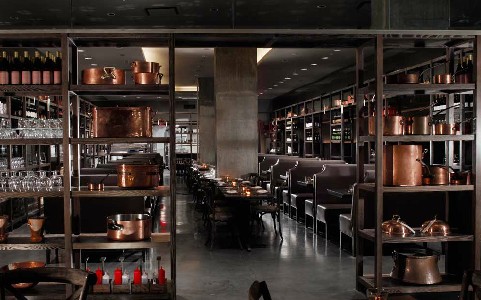 french
speaking waiter). Was it Munich Haupt Brauhaus? Was it Bouillon
Chartier in Paris, or a large “bouchon” in Lyons? Lots of
beer
(22 draft brands, plus up to 70 bottled craft beers from around the
world), the best sausages in New York which made us totally forget the
infamous hot-dogs sold almost everywhere in the Big Apple, and the best
pig's trotter ever (we ordered it as a main and unique meal, served
boneless in a large portion)... Boulud and his executive chef Olivier
Quignon render homage to the traditional French chefs (raise your eyes
up and check their name engraved on the copper pans hanged on the
walls). Lyons has been -and remain- the capital city of the terroir
French gastronomy: we found in the “Tête au Pied” section of the
extensive menu appealing classics like Veal Tongue with Sauce Gribiche,
Roasted Bone Marrow, or Crispy Tablier de Sapeur. Famed parisian
charcutier Gilles Vérot assists Quignon, Boulud and the house
charcutier Aurelien Dufour, to propose, thousands miles away
from
the Rhône Valley, what we consider the best charcuterie in the
Americas. Those dishes are tasting too French, and you would prefer to
make it the American way? OK, so let's go for hot dogs (14 varieties
are available) or those signature burgers which make Boulud's
reputation worldwide. Check our description of the aristocratic DB
Burger in our DB
Bistro Moderne
review); you won't find it at DBGB but,
alternatively, “The
Piggie”, topped with home made pulled BQ pork and jalapeño on a chedar
bun, is another best seller. french
speaking waiter). Was it Munich Haupt Brauhaus? Was it Bouillon
Chartier in Paris, or a large “bouchon” in Lyons? Lots of
beer
(22 draft brands, plus up to 70 bottled craft beers from around the
world), the best sausages in New York which made us totally forget the
infamous hot-dogs sold almost everywhere in the Big Apple, and the best
pig's trotter ever (we ordered it as a main and unique meal, served
boneless in a large portion)... Boulud and his executive chef Olivier
Quignon render homage to the traditional French chefs (raise your eyes
up and check their name engraved on the copper pans hanged on the
walls). Lyons has been -and remain- the capital city of the terroir
French gastronomy: we found in the “Tête au Pied” section of the
extensive menu appealing classics like Veal Tongue with Sauce Gribiche,
Roasted Bone Marrow, or Crispy Tablier de Sapeur. Famed parisian
charcutier Gilles Vérot assists Quignon, Boulud and the house
charcutier Aurelien Dufour, to propose, thousands miles away
from
the Rhône Valley, what we consider the best charcuterie in the
Americas. Those dishes are tasting too French, and you would prefer to
make it the American way? OK, so let's go for hot dogs (14 varieties
are available) or those signature burgers which make Boulud's
reputation worldwide. Check our description of the aristocratic DB
Burger in our DB
Bistro Moderne
review); you won't find it at DBGB but,
alternatively, “The
Piggie”, topped with home made pulled BQ pork and jalapeño on a chedar
bun, is another best seller. This restaurants is worth much more than one visit. First of all because the portions are so generous that one course is usually enough... if not too much: the menu can be enjoyed step by step, on different occasions. Also because DBGB could be visited as a coffee shop: Myriam Eberhardt is a great pastry chef. She is French, worked with 2-Michelin star chef Raymond Blanc, and makes refreshing sorbets and a great “Gâteau Russe” with pistachio mousse and raspberries. Last but not least, the atmospheric DBGB Kitchen & Bar is located off the beaten tracks, in what used to be the equivalent of the South Bronx in Manhattan; impoverished and dangerous, invaded by junkies in the 1970s - 80s, it has been 99% gentrified since a decade (you will still can see a couple of Missions housing the homeless). Half way, both in location and style, between the fashionable Soho and picturesque Chinatown, this is more and more “the place to be”: ideal to enjoy the exciting night life in the city that never sleeps without mixing with the 5th Avenue and Time Square tourists. DBGB is good value for money: you won't pay more than USD 50 for the nice “Menu Fixed Price” (until 7pm); a dinner would cost about USD 40 if, like us, you order only one dish (USD 17 for the Grilled Pig Trotter) and a large glass of organic German (Munich) “Pinkus Ur Pils” (USD 12). DBGB KITCHEN & BAR: 299 Bowery, New York, NY 10003 PHONE: +212 933 5300 RESERVATION
REVIEWS
OF THE BEST HOTELS IN NEW YORK
  |


 culinary
fame in the
late
1980s and early 1990s as the executive chef at Le Cirque. In 1997, the
old Le Cirque space has been annexed by Daniel: the most prestigious
restaurant
in the USA, and the prime dining spot for the Manhattan society and
celebrity.
culinary
fame in the
late
1980s and early 1990s as the executive chef at Le Cirque. In 1997, the
old Le Cirque space has been annexed by Daniel: the most prestigious
restaurant
in the USA, and the prime dining spot for the Manhattan society and
celebrity.  Joël
Robuchon) in 1994, when chef-restaurateur Gilbert Le Coze died
unexpectedly
of a heart attack. First as executive chef, then as co-owner
with
the charming Maguy Le Coze (Gilbert's sister, always present to have a
chat with the guests), he built up a sacred temple of seafood in a
beefeaters'
nation. Active and ambitious in promoting his cuisine, Ripert has his
own
TV show (“Avec Eric” on PBS Television), publishes cook books, and
manages
restaurants in the USA as a consulting chef with the Ritz-Carlton group
of hotels. Le Bernardin remains his headquarters. He was in the kitchen
the day of our visit.
Joël
Robuchon) in 1994, when chef-restaurateur Gilbert Le Coze died
unexpectedly
of a heart attack. First as executive chef, then as co-owner
with
the charming Maguy Le Coze (Gilbert's sister, always present to have a
chat with the guests), he built up a sacred temple of seafood in a
beefeaters'
nation. Active and ambitious in promoting his cuisine, Ripert has his
own
TV show (“Avec Eric” on PBS Television), publishes cook books, and
manages
restaurants in the USA as a consulting chef with the Ritz-Carlton group
of hotels. Le Bernardin remains his headquarters. He was in the kitchen
the day of our visit. 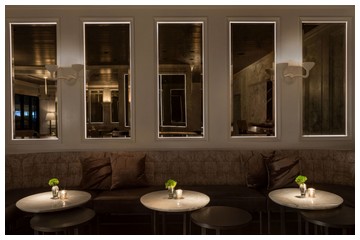 design. It provides guests of the
  restaurants,
including a spacious bar & lounge, decorated in tones of
sunflower
yellow and slate grey. The light filled space is framed by floor to
ceiling windows, pera wood panelling and terrazzo floor. Works by famed
artist Vik Muniz are on display: adding little bit more sophistication
to Thomas Schlesser's refined interior design.
restaurants,
including a spacious bar & lounge, decorated in tones of
sunflower
yellow and slate grey. The light filled space is framed by floor to
ceiling windows, pera wood panelling and terrazzo floor. Works by famed
artist Vik Muniz are on display: adding little bit more sophistication
to Thomas Schlesser's refined interior design. 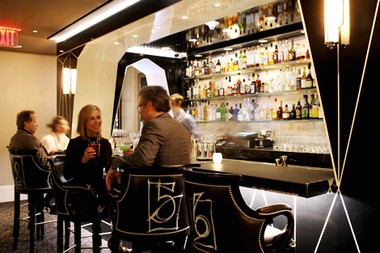 The
intimate dinning room, where all the rich and famous like to sat,
underwent
a cosmetic exercise; it re-opened in October 2009 with a new -though
still
classic- design... and a new chef. Andrew Carmellini left
Daniel
Boulud for Robert de Niro's Locanda Verde; the enthusiastic 30-year-old
Gavin Kaysen took the job over. Promising, one hand left on the Holly
Bible
and the other on a high pile of his boss' cooking-books, to keep on
with
the café main rules: tradition, season, market, and a twist to foreign
kitchens.
The
intimate dinning room, where all the rich and famous like to sat,
underwent
a cosmetic exercise; it re-opened in October 2009 with a new -though
still
classic- design... and a new chef. Andrew Carmellini left
Daniel
Boulud for Robert de Niro's Locanda Verde; the enthusiastic 30-year-old
Gavin Kaysen took the job over. Promising, one hand left on the Holly
Bible
and the other on a high pile of his boss' cooking-books, to keep on
with
the café main rules: tradition, season, market, and a twist to foreign
kitchens. 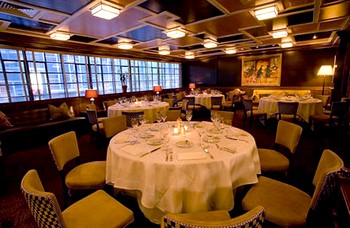 Executive
chef Bill Peet serves a satisfying menu of classic American cuisine,
which
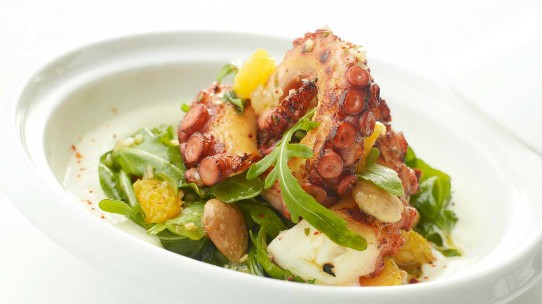
includes "Grilled Baby Octopus" with orzo, tomato, Kalamata olives,
sweet
pea shoots, feta cheese and lemon dressing, "Warmed Duck Salad" with
watercress,
frisée and poached egg in honey-whole grain mustard vinaigrette,
a "28-Day Dry Aged Sirloin" served with Béarnaise or Bordelaise
sauce, "Grilled Smoked Prawns" with roasted tomato vinaigrette and
mache,
"Dover Sole" with baby arugula and crispy shallots and "Dark Beer
Braised
Short Rib" with dry roasted carrots and whipped potatoes. To
finish,
guests can choose from a number of tasty desserts, such as "Grilled
Peaches"
with poached blueberries and crème fraiche, "Steamed Lemon Thyme
Pudding" with port wine, blueberry-vanilla bean ice cream and homemade
Oreo-style cookies.
Executive
chef Bill Peet serves a satisfying menu of classic American cuisine,
which
includes "Grilled Baby Octopus" with orzo, tomato, Kalamata olives,
sweet
pea shoots, feta cheese and lemon dressing, "Warmed Duck Salad" with
watercress,
frisée and poached egg in honey-whole grain mustard vinaigrette,
a "28-Day Dry Aged Sirloin" served with Béarnaise or Bordelaise
sauce, "Grilled Smoked Prawns" with roasted tomato vinaigrette and
mache,
"Dover Sole" with baby arugula and crispy shallots and "Dark Beer
Braised
Short Rib" with dry roasted carrots and whipped potatoes. To
finish,
guests can choose from a number of tasty desserts, such as "Grilled
Peaches"
with poached blueberries and crème fraiche, "Steamed Lemon Thyme
Pudding" with port wine, blueberry-vanilla bean ice cream and homemade
Oreo-style cookies. 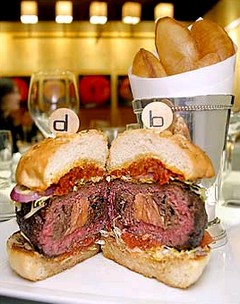 considerations.
Just focussing on one thing: our plate.
considerations.
Just focussing on one thing: our plate. 